
How to spot a fake Pokémon card
Updated on ·8 min read
In short
- Most fake Pokémon cards are exposed by simple checks: the colours of the back, print quality, the light test, the texture of rares and the numbering.
- Always compare with a card you know to be genuine, from the same period and in the same language.
- No app can identify a fake with certainty from a photo: if you paid through a protected system, open a dispute within the time allowed.
In this guide
The eight checks#
To spot a fake Pokémon card, take a card you know to be genuine from the same period and compare the two: back, print, how much light passes through, thickness, finish. Cheap fakes fail the first or second check. The well-made ones, almost always, fail the light test or the texture.
1. The back
It is the first clue, because the back of European-language cards is the same on every card and your eye knows it. Put it next to the back of a genuine card: on fakes the blue leans towards purple or is too light, the shading around the Poké Ball is flat, the outlines are grainy.
2. Print and lettering
Look at the text with your phone’s zoom. Genuine cards have crisp lettering and well-drawn energy symbols. On fakes the text is often smudgy, the typeface is slightly off and the word Pokémon loses the accent on the é. Spelling mistakes and odd wording are an almost certain sign.
3. The light test
Turn on your phone’s torch and rest the card on it. A genuine card lets little light through, and evenly, because there is a dark layer inside it; many fakes light up almost like a sheet of paper. It is also one of the checks listed on The Pokémon Company’s support page on counterfeit cards. Always run the test alongside a genuine card of the same era: the card stock has changed over the years, and a comparison is worth more than any rule.
4. Thickness and edge
Look at the edge of the card with the zoom at maximum: on many genuine cards you can see a very thin, darker line in the middle, the inner layer. Fakes are often thinner and floppy, or stiff and glossy like plastic. The famous rip test, which shows the inner layer by tearing the card, is best left to cards you have already decided to throw away.
5. Holo and texture on rares
Rares have specific finishes. On classic holos the holographic part is the artwork alone; on reverse holos it is everything else. Modern full arts and illustration rares have a raised texture you can feel by running a fingertip over it. Many fakes are glossy all over, with the same uniform rainbow across the whole card, or smooth where the original has texture.
6. Symbols and numbering
The set symbol or code, the number, the rarity symbol and the copyright line at the bottom have to agree with one another. A number that does not exist in that set, the wrong rarity or a copyright year that does not match the release are mistakes a genuine card does not have. Compare the card with the picture on its page in the Pokémon card catalogue.
7. Impossible stats
Some fakes do not even try to copy a real card: Pokémon with thousands of hit points, made-up attacks, VMAX or ex versions that never existed, bundles of all-gold cards sold by the dozen. If you cannot find the card in any catalogue, the reason is usually simple.
8. The price
The last check comes before you even see the card. A sought-after card sold far below its market price almost always has a reason, and it is rarely the seller’s generosity. The same goes for sealed packs at rock-bottom prices, perhaps on a market stall or in a shop that does not deal in cards: ask yourself where they come from.
Well-made fakes: where they slip up#
Recent years have brought very careful fakes, with correct colours and believable holos. They target the cards people are looking for: Charizard from every era, the special illustrations from recent sets, Umbreon, Pikachu. For these a glance is no longer enough. You need the checks that printing cannot imitate cheaply: the light passing through, the texture of rares, the stiffness of the card stock compared with a genuine one.
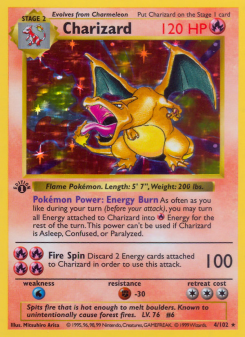
Charizard
Base Set · #4
€620.39

Umbreon ex
Prismatic Evolutions · #161
€700.00

Pikachu ex
Surging Sparks · #238
€195.63
There is also the fake without a fake: the real card in the listing photos and a copy in the parcel. That is why photos are not enough and the card should be checked as soon as it arrives, before you confirm receipt.
The case of Japanese and Chinese cards#
Genuine Japanese cards have a different card stock and finish from European-language ones: comparing them with an English card leads to false alarms. A Japanese card is compared with another Japanese card of the same period, never with a European one.
With Chinese cards there is a frequent misunderstanding. Official Chinese editions exist, with their own sets and numbering: Chinese does not mean fake. It means that to verify one you need a genuine Chinese card, and a catalogue that knows those editions.
Fake slabs and real certificates#
Cases get faked too. There are slabs counterfeited from scratch, with copied labels, and real slabs opened and resealed with a different card inside. The first defence is the certificate number: on PSA’s certificate verification service you enter it and see which card and which grade it corresponds to. The other graders offer similar checks on their websites. If the certificate describes a different card from the one in the case, stop.
A valid number does not settle the matter, though. PSA itself warns that counterfeiters print labels with real certificate numbers, taken from public sources: the number tells you that such a card exists, not that it is the one in front of you. Check the printing on the label, the plastic of the case and the edges too, where opening it leaves marks. For valuable graded cards, buy only with protected payment. How grades, cases and certificates work is explained in the guide to grading Pokémon cards.
Is there an app that detects fake cards?#
The honest answer: no, not one that can give you certainty from a photo. Scanner apps, Cardholo’s included, identify the card: they recognise set, number and variant and show you the price. They do not authenticate it. A well-made fake can be recognised as the card it imitates, because that is exactly what the counterfeiter wants.
The scanner is still useful for an indirect check: it tells you which card it ought to be, so you can compare it with the picture on the card page and make sure number, set and rarity add up. The rest is down to your eyes, a lamp and a genuine card to compare with.
If you have already bought a fake#
Do not put it off. Photograph the card, the envelope and the packaging just as they arrived, and repeat the checks on this page next to a genuine card, filming them if you can.
If you paid through a protected system, open a dispute straight away, within the time limit the service sets, and attach the photos and the video of the checks.
If you paid outside any protection, by bank transfer or by topping up a prepaid card, your options shrink: keep chats and receipts and consider reporting it to the police. The most common scams, and how to avoid them before you pay, are in the guide to Pokémon card scams.
Can you sell fake cards?#
No. A fake card reproduces protected trademarks and artwork, and selling it is trading in counterfeit goods even if the listing says it is a reproduction. Reselling it “to get your money back” only moves the damage on to the next collector.
Players know proxies, the home-made prints used to try out a deck before buying the real cards. They stay on the kitchen table. When they turn up in a listing as a “collector’s replica”, they are fakes with a kinder name.
Frequently asked questions
How can I tell if a Pokémon card is fake?
Compare it with a card you know to be genuine from the same period: the colours of the back, the sharpness of the print, the accent on Pokémon, how much light passes through with your phone’s torch, the texture of rares, whether number and symbols agree. Cheap fakes fail at once; careful ones usually fail the light test.
Is there an app to detect fake Pokémon cards?
No app can guarantee that a card is authentic from a photo. Scanners like Cardholo’s recognise set, number and variant and show the price, but they do not authenticate the card: that check is done by hand, with a genuine card to compare.
Are Chinese Pokémon cards fake?
Not necessarily: official Chinese editions exist, with their own sets and numbering. A Chinese card should be compared with a genuine Chinese card, not with a European one.
How do you spot a fake PSA slab?
Verify the certificate number on the PSA website and check that it matches the card and grade in the case, then examine the label, the plastic and the edges. A valid number is not enough: PSA warns that counterfeiters use real certificate numbers.
Is it legal to sell fake Pokémon cards?
No: a fake card is counterfeit goods, and selling it does not become lawful by writing that it is a reproduction. If you have one, keep it as a reference for comparison or throw it away.
I bought a fake Pokémon card: what can I do?
If you paid through a protected system, open a dispute within the time allowed and attach your evidence. With a bank transfer, a prepaid-card top-up or a “friends and family” payment, getting your money back is much harder.
On Cardholo
Related guides
Pokémon card scams: how to spot them and avoid them
“Friends and family” payments, copied photos, weighed packs, fakes and bogus buyers: the most common Pokémon card scams and how to buy protected.
Updated on 27 September 2026Condition and gradingHow to get Pokémon cards graded from Europe, step by step
PSA, BGS, CGC or GRAAD: how to choose a company, prepare and ship your cards, with timings and middlemen. Grading from Europe, step by step.
Updated on 27 September 2026Condition and gradingCard conditions: the scale from Mint to Poor, with examples
What MT, NM, EX, GD, LP, PL and PO mean, how to check corners, edges and surface, and how much condition moves the price. With a conversion table.
Updated on 27 September 2026